Case Study · Naukri (Info Edge) 2026
AI hiring team for recruiters.
Hiremate gives recruiters an AI hiring team from Naukri — agents that source, screen and engage candidates round the clock, built on our ATS, Zwayam. Strategy, research, agent architecture and a six-agent system, designed and shipped as a working prototype in code.
Designed & shipped in codeModern UX process
2 months idea → shipTurnaround
IC LeadMy role
Claude Code + MakeToolstack
How this story runs
Five acts, from market to shipped code.
A product-design case study told thinking-first — every act closes on a decision that shaped the next one.
Act IGround truthA two-word brief, what the market is building, what recruiters actually feel.
Act IIStrategyA new design domain, three product bets, and the one that won.
Act IIIProcessAn AI-native double diamond — six directions, seven probes in parallel.
Act IVThe productSix agents, the trust layer, five working surfaces.
Act VCraft & proofCode-level calls a diagram can't show — and what shipped.
Where it started
The whole brief was two words: recruitment, and AI agent.
No spec, no feature list, no screens to redraw. Everything that follows is how two words became a working six-agent product — and every step of the thinking in between.
Act I of V
I.
Ground truth
Before a single screen: what the market promises, and what recruiters actually feel about AI doing their work.
Market scanCapability mapFour market storiesIn-person researchRecruiter journeyNine mindsetsCombined learning
Market · Full capability map
Semantic understanding of candidates & roles
DepthNatural-language searchSearch
Multi-step reasoning on job descriptionsReasoning
Agent personas with clubbed capabilities
AgentsAutonomous agents from sourcing to outreachAutomation
High-volume personalised outreachOutreach
Multi-channel outreachOutreach
Continuous reruns of jobsAlways-on
Multi-agent setup per roleAgents
Always-on outbound engine that keeps discovering
EngineNot a one-shot search toolModel
Agentic AI + expert recruiters combined
HybridDelivers interview-ready slatesOutput
Engagement models from per-role to AI agencyModel
Skills graph & talent intelligenceIntelligence
Automation across internal + external talentReach
Rediscovers past ATS candidates for the role
RediscoveryTalent "operating system" where agents surface
PlatformDrives skills-based internal + external hiringSkills
Résumé fraud detection
IntegrityAI phone screeningScreening
AI schedulingScheduling
Automated fraud-aware flow for high volumeSpeed
"Human-like" AI interviewer
ExperienceRecruiter bias reductionFairness
Richer, fairer signals than résumésSignal
All-in-one recruiting workspacePlatform
Outcome predictionsSignal
Willing-to-move signalsSignal
Rich, multi-format assessmentsAssessment
Visual "agent builder" to design funnels
BuilderInbound Agent with explainable scoringExperience
What the market is building
Same features everywhere — but four different stories about the recruiter.
Across 30+ players the capabilities repeat. What actually splits the market is the relationship each product proposes between the agent and the person.
Story 01Works alongside me
Suggests, explains, waits. The recruiter keeps every decision — the agent earns its place call by call.
Story 02Does my work for me
Brief it once and sourcing-to-outreach runs on its own. The recruiter reviews output instead of doing the task.
Story 03My work, and beyond
Always-on engines that rediscover, re-engage and screen at a volume no human hours could ever reach.
Story 04Replaces me
AI interviewer to interview-ready slate, end to end — the recruiter is optional by design.
Semantic understandingNatural-language searchMulti-step JD reasoningAgent personasAutonomous sourcing → outreachAlways-on outbound engineMulti-channel outreachRediscover past ATS talentSkills graph & talent intelRésumé-fraud detectionAI phone screeningAI schedulingMulti-format assessmentsRicher-than-résumé signalsExplainable scoringAgentic AI + expert recruiters
The User Perspective
I met recruiters to hear their views on AI & agentic work.
I sat at their desks, watched the real workflow, and listened — in-house teams, IT-staffing firms, agencies, plus recruiter creators on social read through NotebookLM. One question ran underneath: which parts of hiring would they never give up, and which would they hand to an agent tomorrow?
3 segmentsEnterprise · SMB · Consultant
Roundtables + 1:1sTA experts & recruiters
On-desk shadowingWatched the real workflow
Creators on socialRead through NotebookLM
Nine Mindsets · 1–3
What recruiters actually feel about AI.
01 · AI tool fatigueOverwhelmed by AI tools
Leaders fear stacking so many disconnected tools that in a few years they'll own hundreds of AIs nobody knows how to navigate.
"In a few years we'll have hundreds of AIs nobody knows how to use."
— Agency lead
02 · Expertise & controlDon't take away my controls
Experts live on Boolean logic, precise exclusions and rapid visual feedback — years of muscle memory. Conversational AI felt like a step backward.
"Explaining context to AI takes longer than ticking filters I know by heart."
— IT-staffing recruiter
03 · Human nuanceAI can't read between the lines
A model trained on stability metrics rejects a 1-year stint — a human reads the nuance: a family break, a career pivot.
"A 1-year stint isn't a red flag — it's a human story."
— In-house TA
Nine Mindsets · 4–6
The grind they want gone.
04 · Sea of samenessRésumés all look the same now
Generative AI tailors résumés perfectly to any JD — polished, keyword-optimized applications, and a near-zero barrier to apply.
"Everybody copies a JD and creates a résumé in 30 seconds."
— Agency recruiter
05 · Busywork drainTake the grind off my plate
Hours vanish hopping portals to stitch one candidate list together — that hunting is where time leaks, not where judgment lives.
"Keep the list full for me — I'll spend my hours on people, not portals."
— IT-staffing recruiter
06 · Depth detectionTell the doers from the watchers
Systems flatten complex careers into text strings — recruiters burn hours opening résumés to check who actually did the work.
"Python 8 years ago looks identical to someone who used it yesterday."
— IT-staffing recruiter
Nine Mindsets · 7–9
Where they want AI to make them sharper.
07 · Warm rediscoveryRe-engage people I already know
Every past search leaves a trail of strong, half-warm candidates — surface those before starting from zero.
"Someone I've engaged before closes quicker than anyone I find new."
— Agency recruiter
08 · Delegate the routineTrade volume for the hard roles
High-volume, look-alike hiring eats the calendar and rarely needs senior judgment — unload it, keep the niche searches.
"Many IT roles are similar and can be delegated to my juniors."
— In-house TA
09 · Market briefingBrief me before high-stakes talks
A fast read on the role, the skills and the market — walk in guiding the conversation, not catching up to it.
"I use AI to get smart on a role before I ever step into the room."
— IT-staffing recruiter
Combined Learning · User × Industry
Two streams kept landing on the same directions.
The market scan showed the industry's pace; recruiter interviews uncovered the friction. Pinned side by side along the funnel — requisition & sourcing first.
01 · RequisitionTurn a vague brief into a market-sharp, competitive JD
User- "I use AI to get smart on a role before I step into the room."
Industry- Multi-step reasoning on JDs, primed with live market data.
01 · RequisitionCo-create glass-box criteria — never a black-box score
User- "Don't take away my expertise and the controls I know by heart."
Industry- Inbound agents with explainable, auditable scoring.
02 · SourcingOne natural-language query, every source searched in parallel
User- "Keep the list full — I'll spend my hours on people, not portals."
Industry- Unified search + an always-on outbound engine.
02 · SourcingRevive silver-medalists before starting from a cold list
User- "Someone I've engaged before closes quicker than anyone new."
Industry- Rediscovers past ATS candidates for the open role.
Combined Learning · User × Industry
…and again at screening & the interview loop.
03 · ScreeningSurface depth — tell the doers from the watchers
User- "Python 8 years ago looks identical to someone who used it yesterday."
Industry- Semantic skills graph & talent intelligence.
03 · ScreeningRead résumés for human nuance; flag AI-polished sameness
User- "A 1-year stint isn't a red flag — it's a human story."
Industry- Résumé-fraud detection + richer-than-résumé signals.
04 · InterviewAuto-run the loop — scheduling, feedback, keeping candidates warm
User- "Take the unproductive grind off my plate."
Industry- AI scheduling + always-on coordination.
04 · InterviewRole-fit, unbiased assessments feeding data-driven picks
User- "Add objective criteria over pure intuition."
Industry- Rich, multi-format assessments + bias reduction.
Act II of V
II.
Strategy.
Name the real design challenge, bet three genuinely different ways, and keep only what survives contact with a real recruiter.
A new domainThe designer's mirrorThree product betsThe decision matrix
The core design challenge
Agentic experience design is a new domain.
No pattern library, no settled rules — this discipline is being invented as products ship. Three questions had no existing answer, and one thing sat underneath all of them.
Question 01 · ConversationHow do you design a conversation that does real work?
Natural language is what makes an agent feel like a colleague — and exactly what lets a user wander off and get lost. The rails have to be designed in, invisibly.
Question 02 · ContinuityHow does one product stay continuous across states and agents?
A hire runs for weeks — sourcing, screening, interviews, different agents on each. Where does context live when no single screen owns the journey?
Question 03 · PersonalityHow much personality does an agent get?
An agent is closer to a coworker you introduce — something you name and explain the limits of. How deep does that character go before it gets in the way?
Under all three, the mirror: if designers feel anxious about AI doing design, a recruiter feels the same about AI judging who gets hired. That anxiety is part of the design material.
The frame that shaped everything
None of these had an answer sitting inside the brief. So I built a few rough, half-formed answers — and watched which survived contact with a real recruiter.
Early bets · Bet 01 of 03
Talent Cloud.
Tested — didn't win
Everything Naukri does, stitched into one surface — natural language on top, agents invisible underneath.
Early bets · Bet 02 of 03
Naukri Copilot.
Tested — didn't win
One assistant that follows you across whichever Naukri product you're in — context never resets.
Early bets · Bet 03 of 03
Goal-based agents.
This one won
The help itself is what you interact with — a sourcing agent, a screening agent, an interview agent, each quietly using whatever Naukri needs underneath.
Early bets · Decision matrix
Why goal-based won.
One question — where does the agent live? Scored on the four things that actually decided it.
Act III of V
III.
An AI-native process
Craft stops being the bottleneck — judgment becomes it. AI for divergence and synthesis at machine speed; me for intent, taste, and the calls that matter.
The shiftAI-native double diamondThe toolchainSix directionsSeven probes in parallelThree modes
AI-Native Design Process
Craft stops being the bottleneck. Judgment becomes it.
The old centre of gravity
How to design
- Pixels, screens, redlines
- Craft is the bottleneck
- One direction at a time
- Weeks to a testable artefact
→
Where it moved
Why to build
- Intent, framing, judgment
- Taste is the bottleneck
- Many directions in parallel
- Hours to a living concept
The AI-Native Double Diamond
Same four moves — AI blows the divergent halves wide open.
01 · DiscoverGenerate context, not just gather it — roundtables alongside AI deep-research, in parallel.
02 · DefineSynthesis at machine speed — threads connected into mindsets and the bets that followed.
03 · DevelopConcept to interaction in hours — many paradigms prototyped at once, not one at a time.
04 · DeliverCode-first interaction design — one living prototype, pressure-tested with partners.
The Toolchain
Eight tools, one human in command.
NotebookLMResearch synthesis — connecting roundtables, interviews and secondary sources into themes.
PerplexityDeep research on positioning, features and the competitive landscape.
MANUSStructured competitor product teardowns, crawled and distilled.
StitchRapid AI-generated UI explorations — concepts in hours, not weeks.
Figma · Figma MakeAssembling validated concepts into cohesive, end-to-end interactive flows.
Claude CodeCode-first refinement of interaction micro-details until it felt real.
ObsidianOne shared notebook — context notes in markdown that every tool in the chain could read.
Human-in-commandMe — framing the why, holding the line, making the calls AI can't.
Six Strategic Directions
Friction, turned into direction.
i · HMWCapture one intent across every hiring need
The answerOne NL intake detects intent and routes to the right workflow.
ii · HMWKeep AI & human close at every step
The answerA shared workspace — human-in-command throughout.
iii · HMWBring market research in early
The answerDemand-supply gaps, salary bands & JD optimisation at intake.
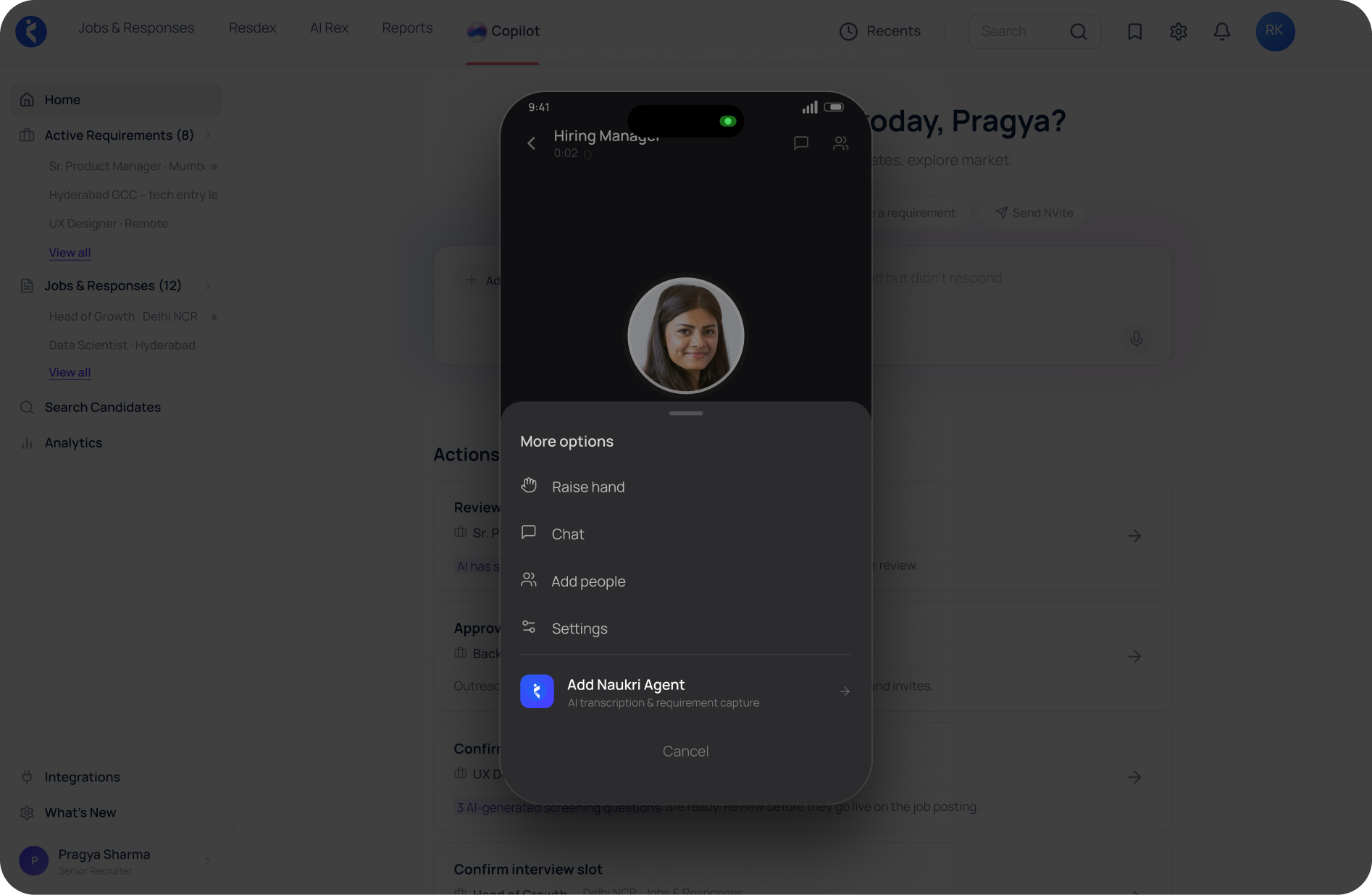
iv · HMWCapture requirements with least effort
The answerAI listens to the briefing call and fills fields live.
v · HMWBuild one multi-platform talent pool
The answerOne query across Resdex, hirist, iimjobs & the internal ATS.
vi · HMWRe-discover past talent
The answerAgents resurface silver-medalists as roles reopen.
HMW → Ideas
Probes i & ii — a working answer to each.
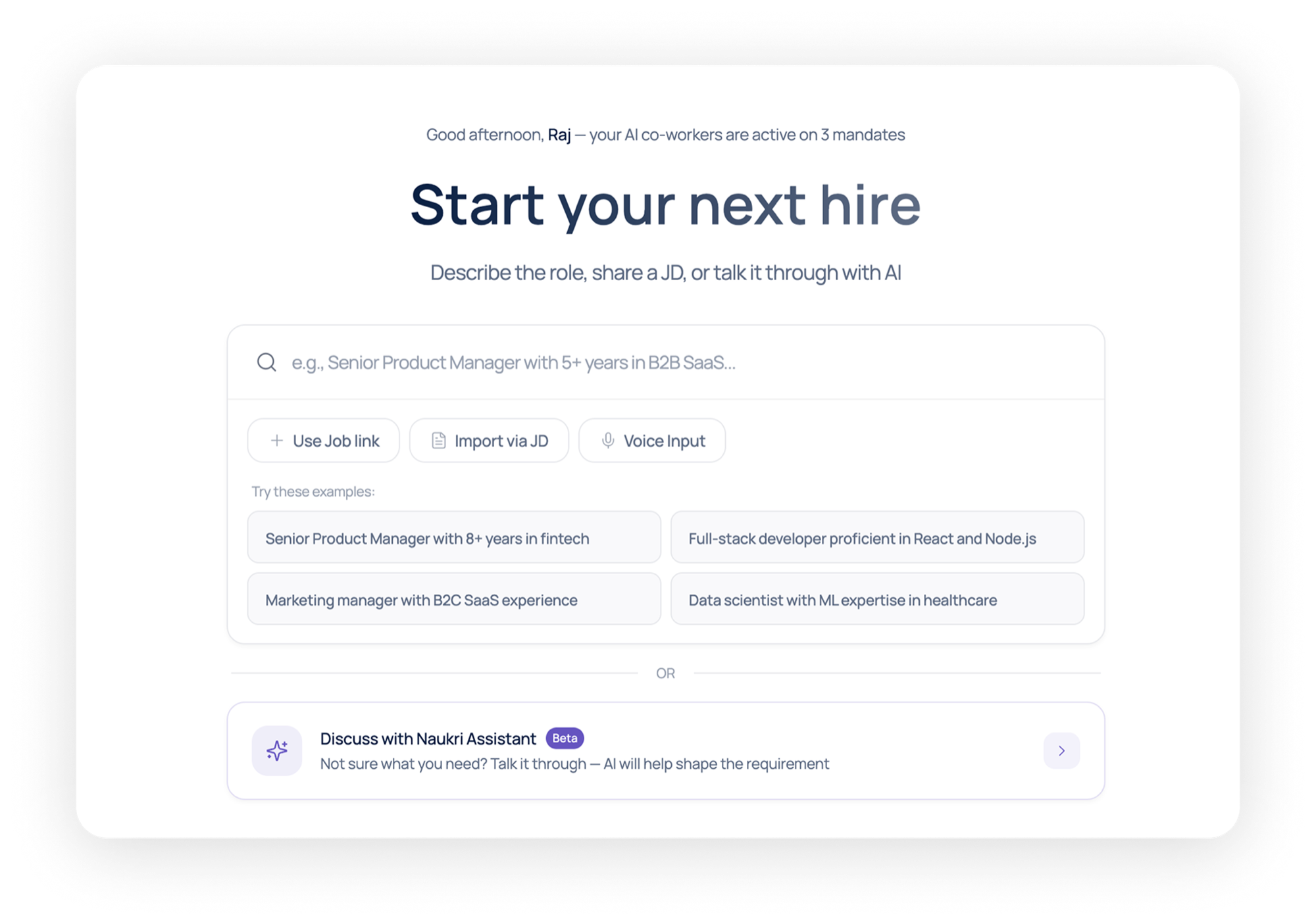 i · RIA — Intake
Universal Intent Intake
One NL brief detects intent and routes across the ecosystem — tool-switching gone at step one.
 ii · The Workspace
The Mandate Canvas
Eight connected nodes on one surface, human-in-command end to end — beats a wall of tabs.
HMW → Ideas
Probes iii & iv — a working answer to each.
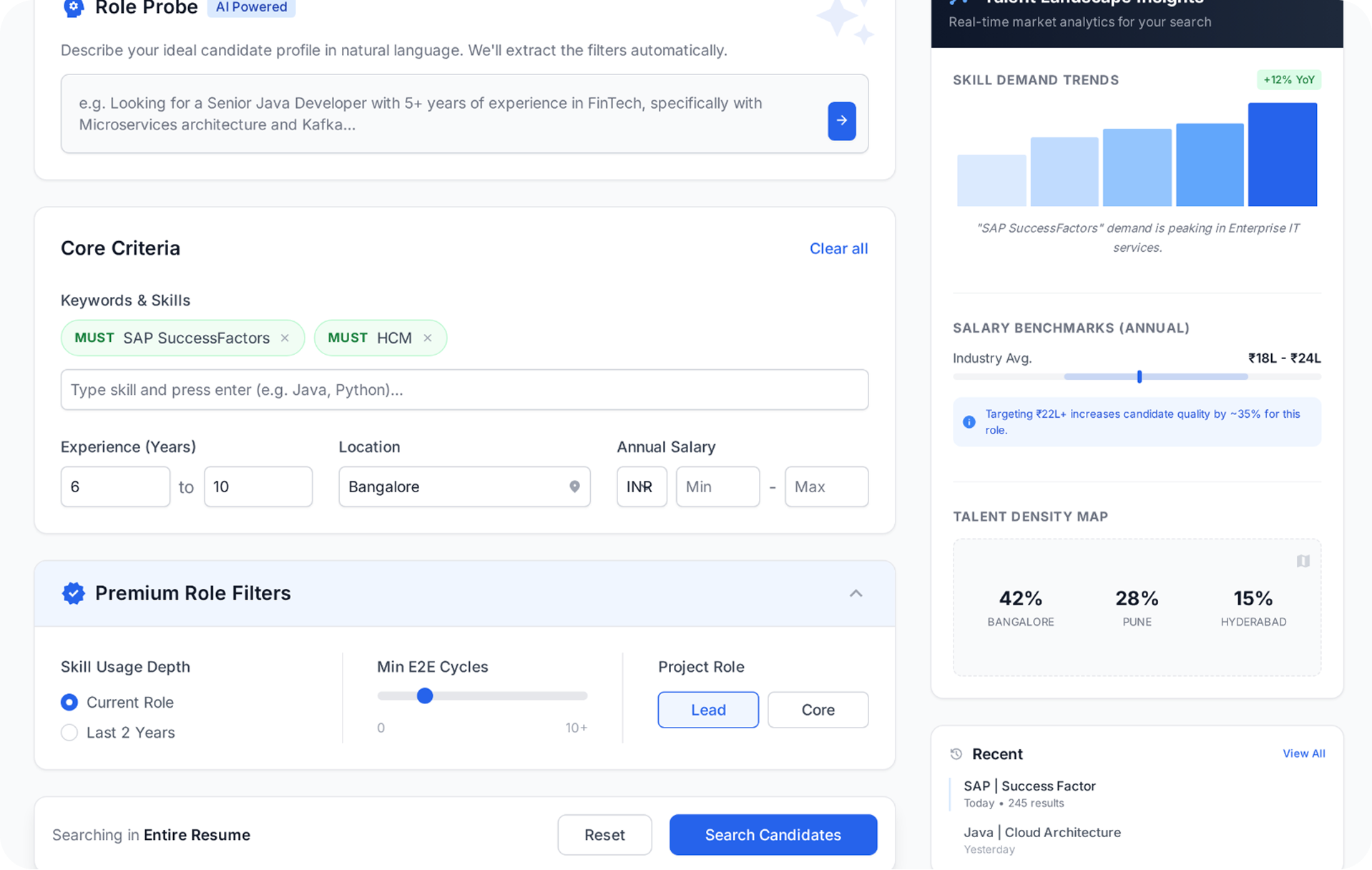 iii · KAI — Analytics
Market Reality at Intake
Fillability 72%, ₹38–68 LPA, 14 active competitors — surfaced before sourcing begins.
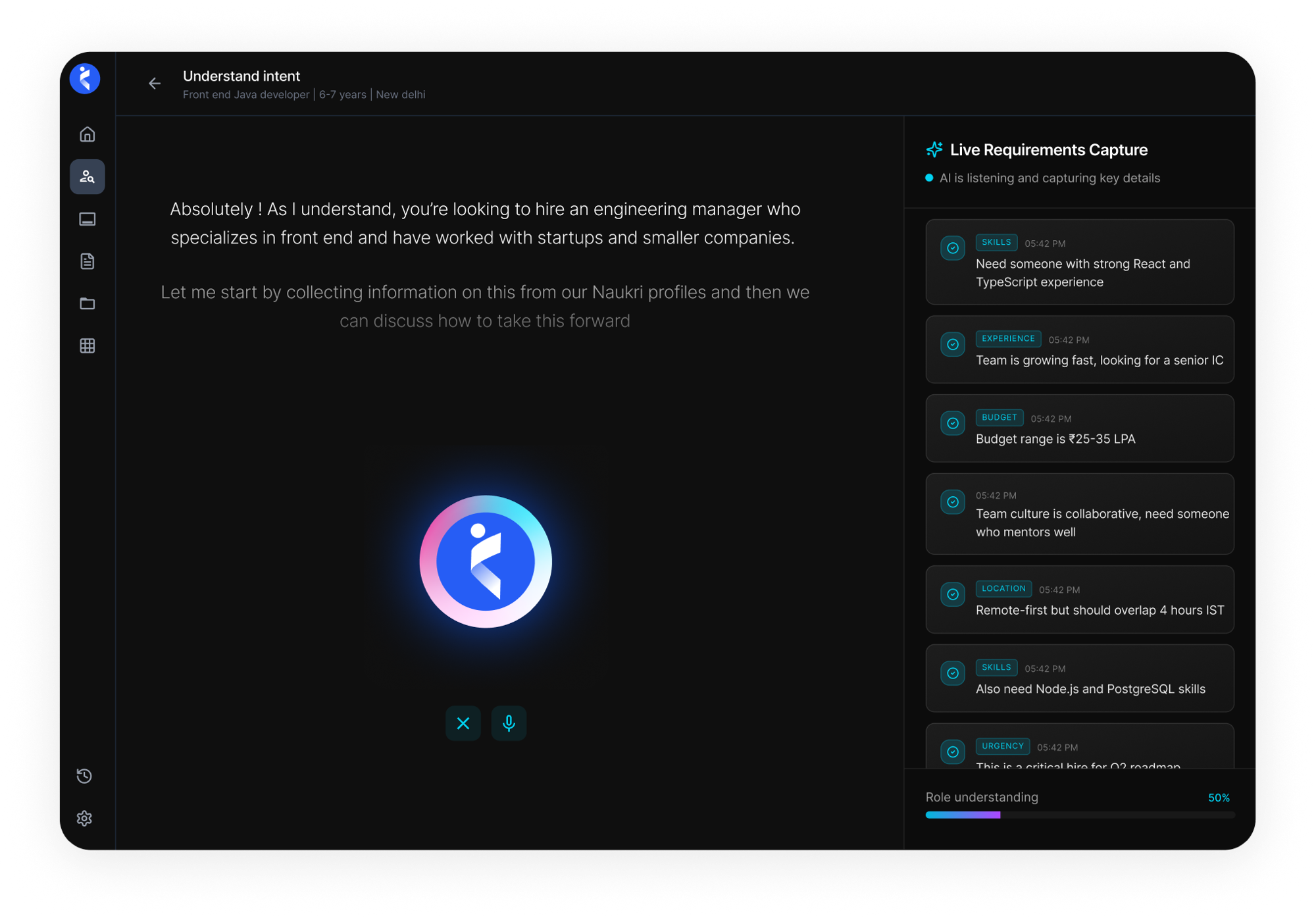
 iv · RIA — Requirements
Live Requirements Capture
AI listens to the briefing call and fills fields live — role understanding climbing in real time.
HMW → Ideas
Judged on signal, not polish.
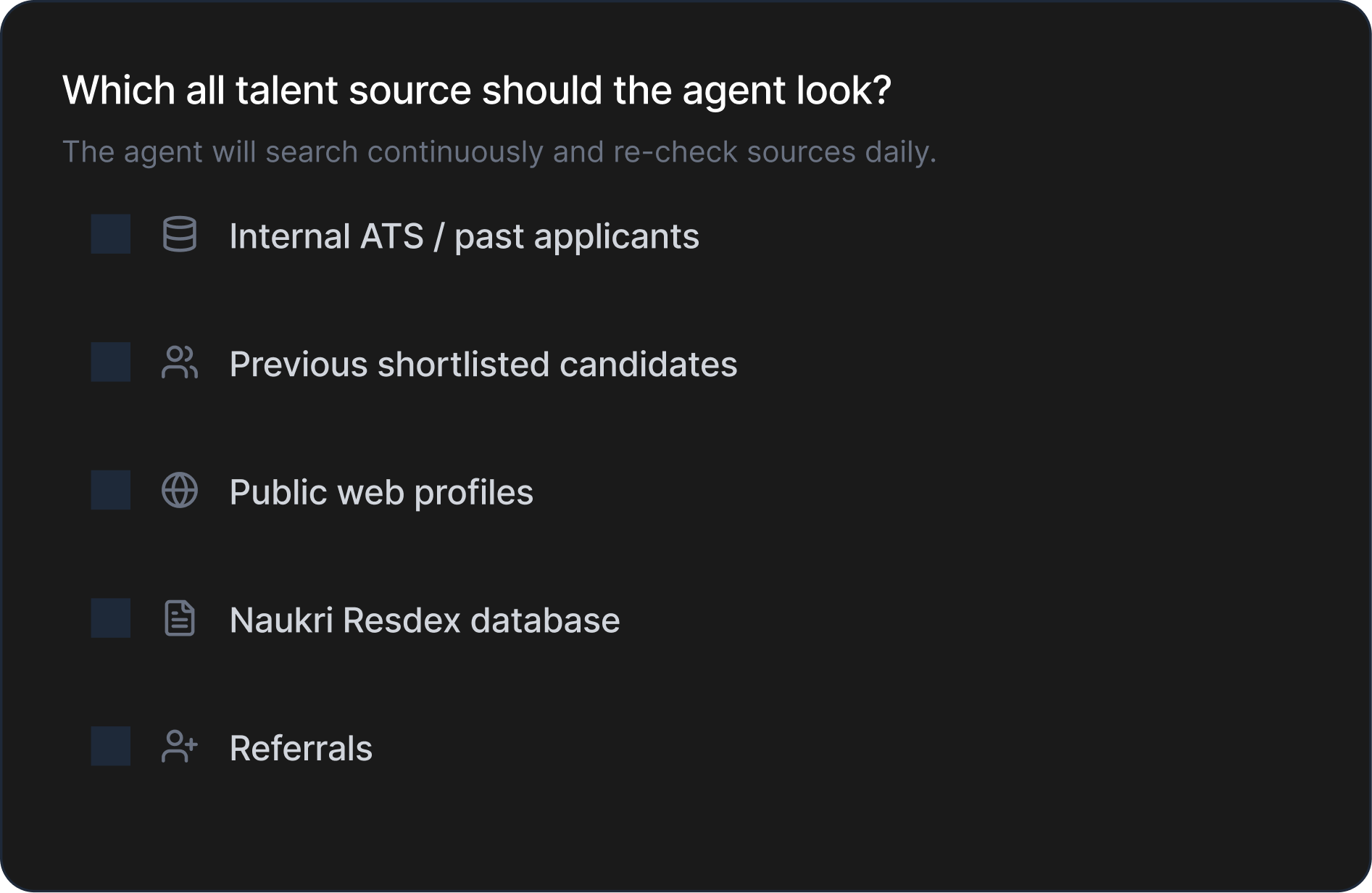 v · NOVA — Sourcing
One Pool, Every Source
A single query across Resdex, ATS, past applicants, web & referrals — silver-medalists resurfaced.
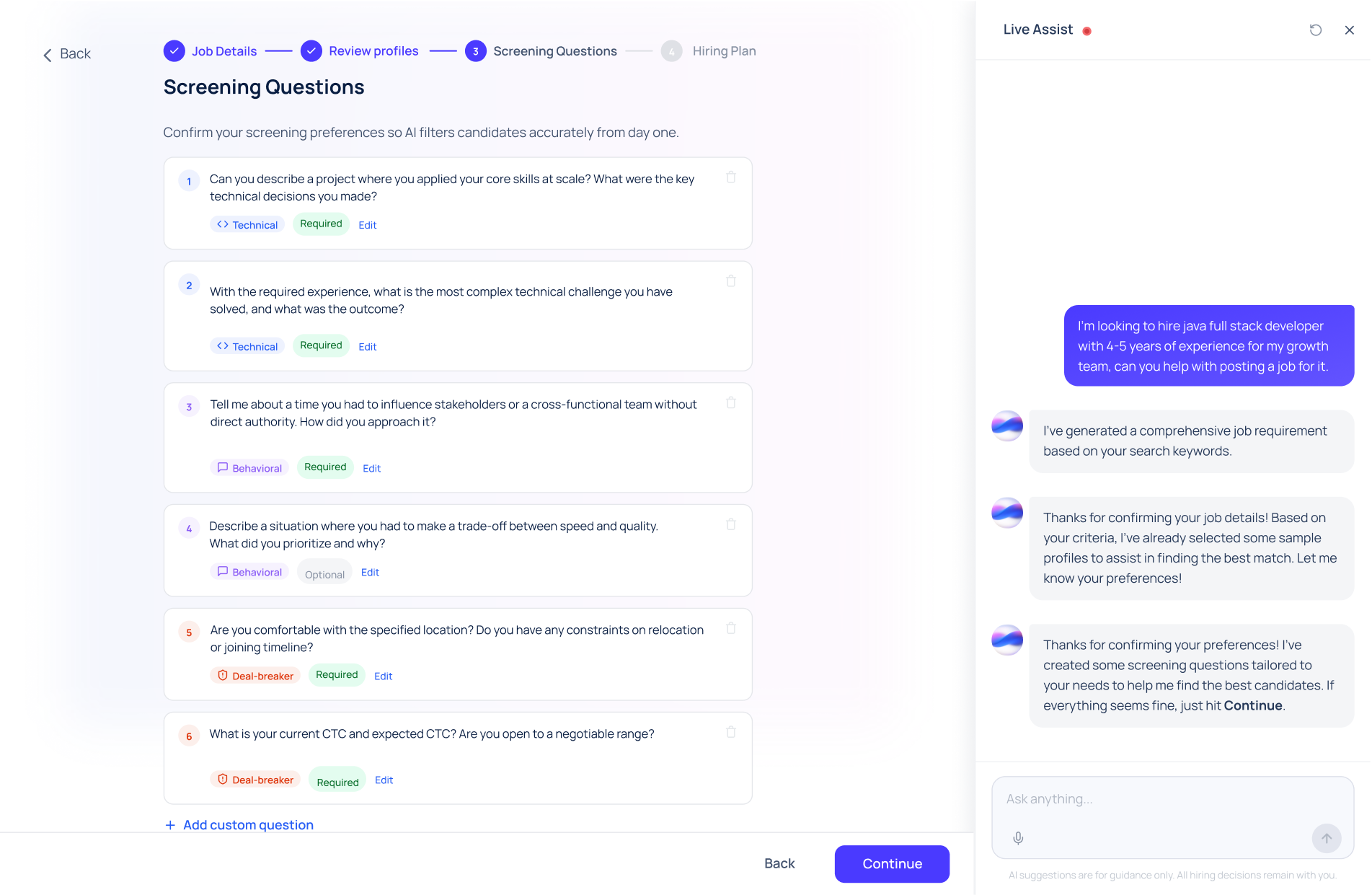 vi · Screening
Glass-box Screening
A co-created question set — technical, behavioral, deal-breaker — every card editable and explainable.
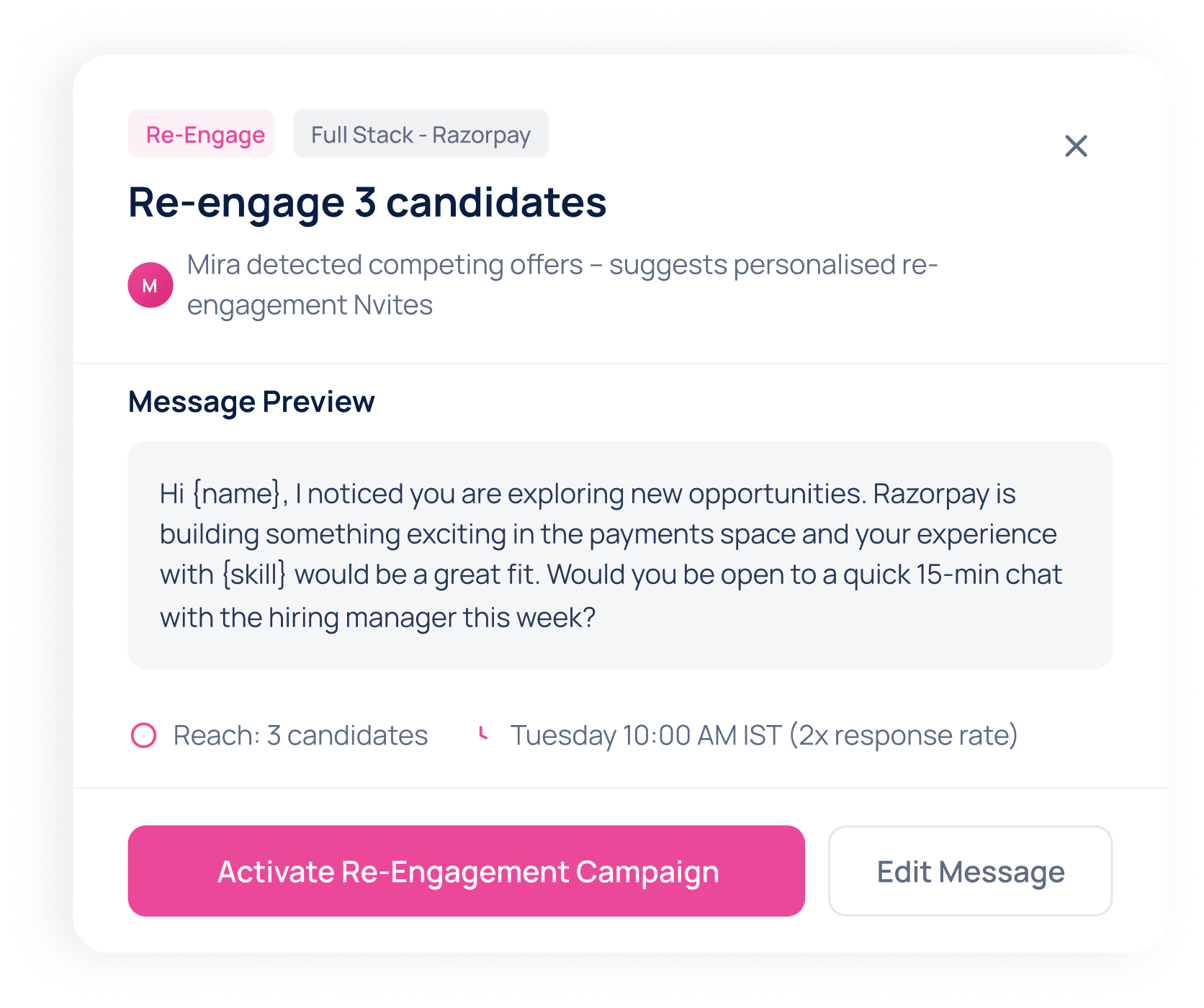 vii · MIRA — Outreach
Re-Engage Campaigns
Spots competing offers and drafts personalized Nvites at ~2× response — without the manual grind.
Three Modes
The agent plays a different role in each.
Read across the funnel, the directions cluster into three modes a recruiter actually works in. Each mode wants a different kind of help.
Mode 01 · 9 needsDeep work of hiring
"Like a research analyst sitting beside the recruiter — ready the moment she asks."
Reading the brief, researching the role, sourcing, screening. The copilot surfaces signal and shows its logic — never hides behind a score.
Mode 02 · 6 needsHandoff to the manager
"Like a coordinator who packages the brief and chases the sign-off."
Shortlists, comparisons, approvals — Emily's thinking packaged for someone else's consumption. Nudges when a decision stalls.
Mode 03 · 6 needsCoordinating the loop
"Like an executive assistant keeping every party in sync."
Scheduling, feedback synthesis, keeping candidates warm — flags blockers and delays before they stall the loop.
Act IV of V
IV.
The product
Agentic systems break the rules of traditional UX — Hiremate answers each break with a specific, buildable design decision.
Four failure modesEight → sixThe teamThe curtainCalibrationPipeline variantsFive surfaces
Where agentic UX breaks
Agentic systems break the rules of traditional UX.
The hybrid trap first: mixing chat and agentic execution on one surface fragments trust. Hiremate keeps them separate — natural language for intent, dedicated agent workspaces for execution. Then four harder breaks:
Invisible reasoningUsers see outcomes, not logic
Hiremate's answerGlass-box screening: every card carries a plain-English fit reason — never a score without a sentence.
Autonomy ambiguityWhen should the agent act vs. ask?
Hiremate's answerAn escalation model — acts silently on sourcing & scheduling, surfaces the moment a call needs judgment.
Misaligned intentVague briefs cause downstream drift
Hiremate's answerProgressive clarification — the Define agent locks a verified brief before sourcing begins.
Context fragilityState lost across handoffs
Hiremate's answerOne shared workspace every agent reads — context lives in one place, not passed between agents.
From Challenge to Design
Two HMW that shaped the agentic layer.
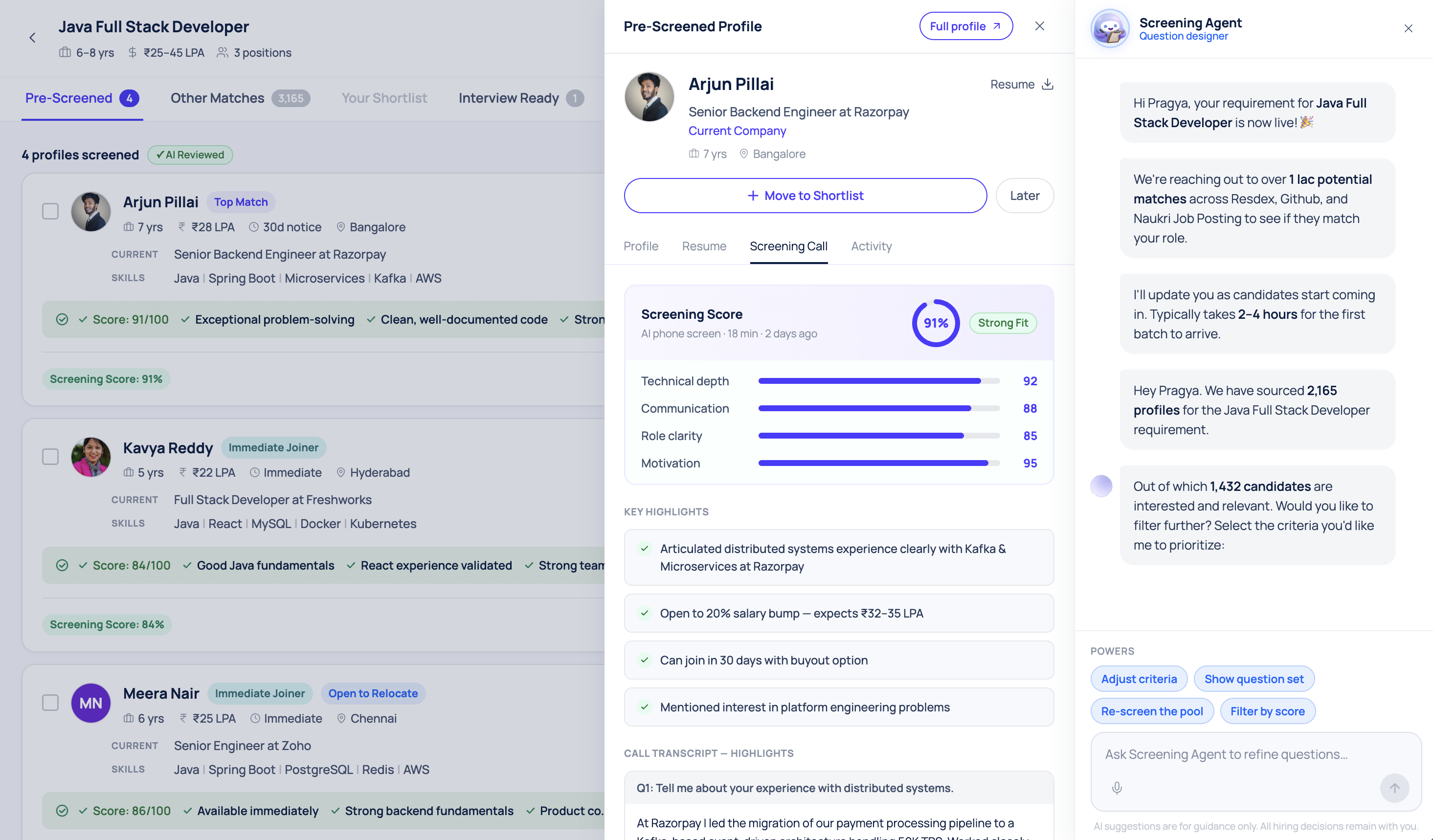 A · Invisible reasoning
Fit reasoning on every candidate card
"Strong on Java + fintech, 18-day notice, in-band salary." One sentence per candidate — the logic behind the score.
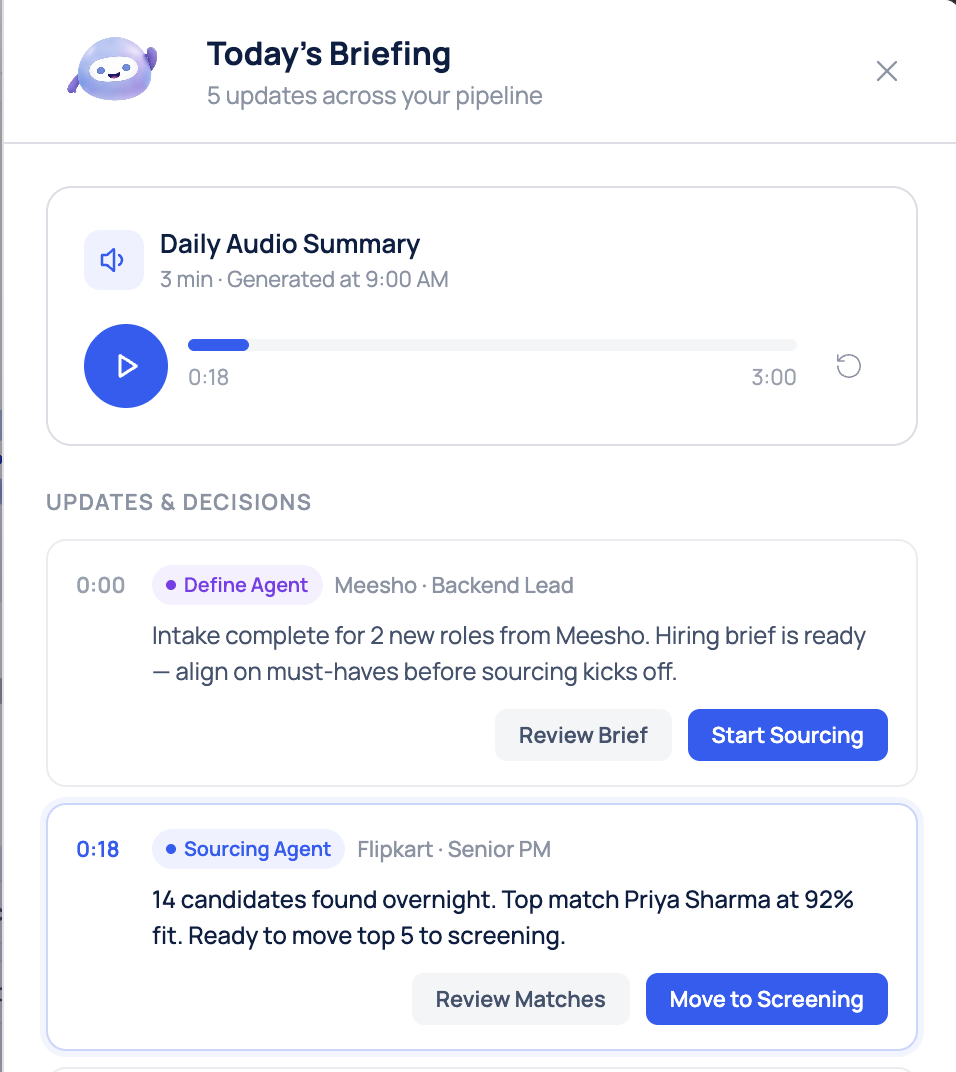 B · Autonomy ambiguity
The orchestrator escalation model
Acts silently on sourcing & scheduling; surfaces when a call needs judgment — in-command without babysitting.
From Challenge to Design
Two more HMW — closing the design loop.
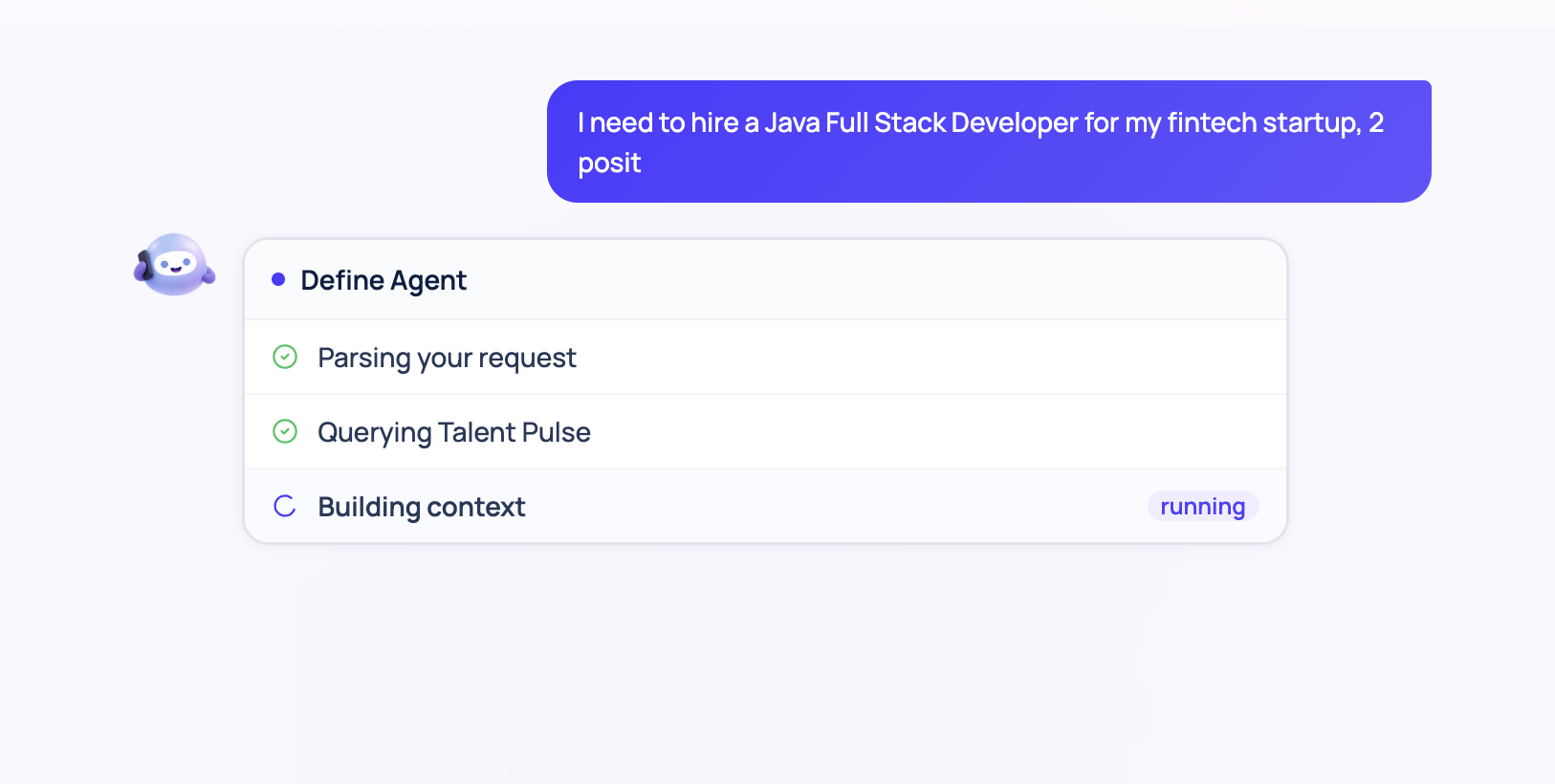 C · Misaligned intent
Progressive clarification before lock
"Sr. PM, Mumbai, 6–8 yrs, ₹25–45 LPA" — one message becomes a verified brief the recruiter confirms.
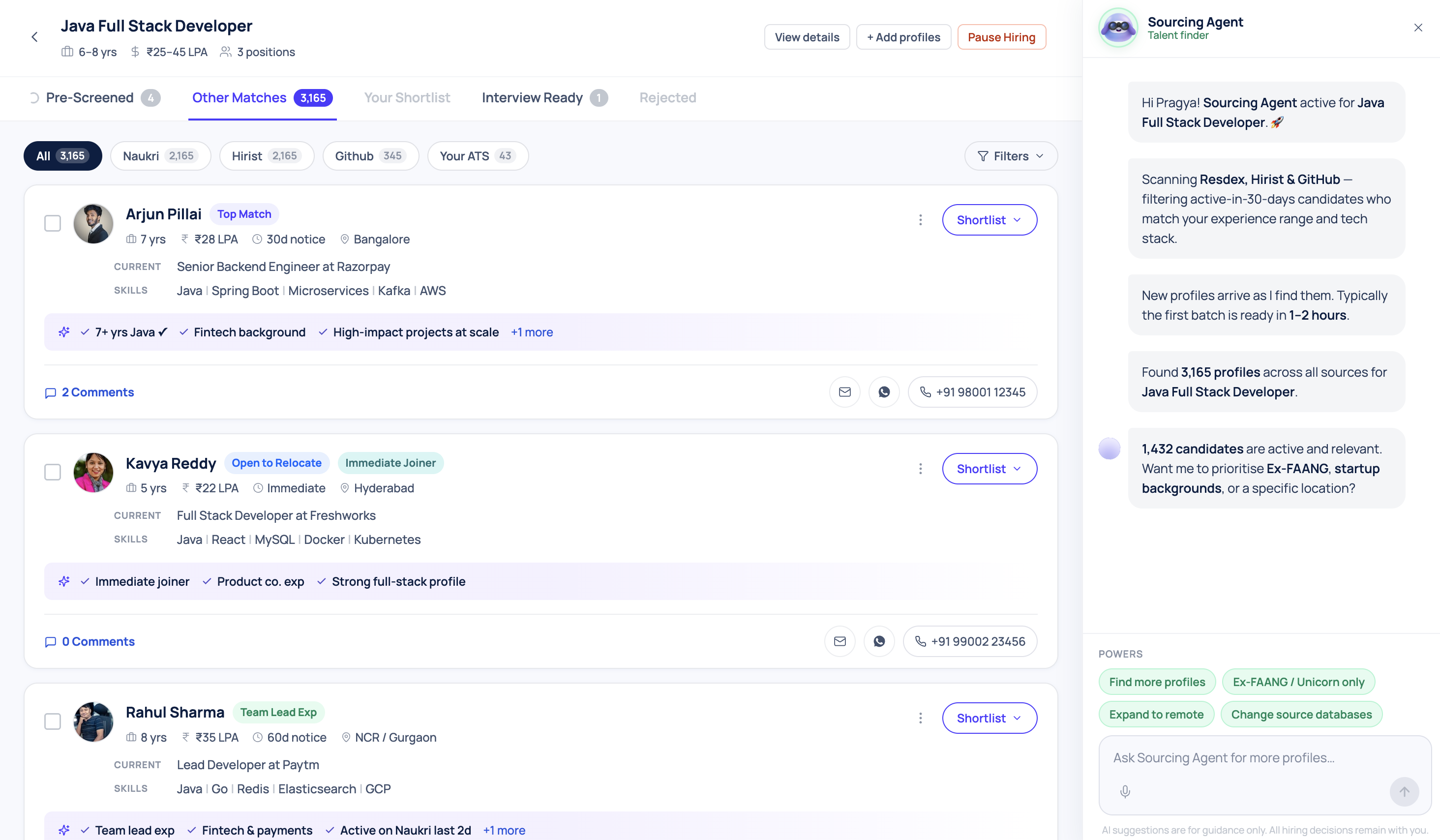 D · Context fragility
One persistent mandate canvas
Brief, pool, criteria, pipeline — one surface, one source of truth. Nothing summarized in transit.
Naming the team
Eight task-agents were too many. Nobody wants eight direct reports on day one.
Early on there were closer to eight separate agent identities — named like features, not teammates. So I collapsed it; every old identity still maps onto a survivor underneath.
Orchestrate →Hiremate
Coordinate & plan the hire
Intake →Define
Define the role
Find →Sourcing
Source profiles
Filter →Screening
Screen resumes
Assess →Interview
Run interviews
Book →Scheduler
Schedule slots
FoldedEngage
Outreach & re-engage
→ folds into Hiremate
FoldedSync
HM review, handoffs & post-offer
→ folds into Hiremate
The Product · Introducing Hiremate
One orchestrator. Five specialists.
Reads the brief, routes work, watches signals — escalates when judgment is needed.
Engages on every conversation, answers any question, routes it to the right agent.

Define
Intake → BriefTurns a plain chat into a structured brief — zero forms.
"Need a Sr. PM in Mumbai, 6–8 yrs, ₹25–45 LPA" — a complete brief in one message.

Sourcing
Brief → LonglistSearches 9.5 Cr Resdex profiles plus the open web, continuously.
Resurfaces silver-medalists the moment a similar role reopens.

Screening
Longlist → ShortlistA plain-English fit reason for every candidate — no blind scores.
"Strong on Java + fintech, 18-day notice, in-band salary."
Interview
Shortlist → SignalDrafts questions and runs vernacular voice screens.
A Hinglish voice screen on WhatsApp — on the candidate's commute.

Scheduler
Signal → CalendarBooks interviews on every calendar — zero clicks.
A panel of 3, time-zone aware — reschedules itself on a decline.
Recruiter always decides · Mechanism 01
Proposals, never actions.
The trap is asking someone to trust a judgment they can't see — so nothing happens quietly. Anything that matters — share, reject, shortlist, invite — slides in as a plain, timestamped list the recruiter has to approve. Fire it.
Sourcing · proposedjust now
- 09:41 Read the locked brief — Sr. PM, Mumbai, 6–8 yrs
- 09:41 Scanned 9.5 Cr Resdex profiles + open web
- 09:42 Re-found 4 silver-medalists from a past role
- 09:42 Wants to move 38 candidates to Screening
Move to ScreeningNot yet
Recruiter always decides · Mechanism 02
You set the bar before the AI does.
Before an agent judges real candidates, the recruiter judges a small sample. Mark each — the system lines its own bar up to match, and only then starts scoring the pool the way you would.
Screening · calibrationsample of 5
Ananya R.7 yrs · fintech PM · Mumbai · shipped paymentsGood
Vikram S.4 yrs · B2B SaaS · Pune · no fintechBad
Meera K.8 yrs · payments PM · Bengaluru · 45-day noticeGood
Rohit D.3 yrs · associate PM · Delhi · early careerBad
Sana Q.9 yrs · lending PM · Mumbai · ex-unicornGood
Bar calibrated 5 / 5 — the agent now scores like you
One panel, three depths
A backfill, a senior hire, a resume pile — same panel, different depth.
Not three tools — three pipeline variants through one underlying panel. The shape of the interaction never changes, only how deep it goes; learn one and the others already feel familiar.
Variant 01 · 3 movesQuick backfill
Scope the role → Sourcing → Plan. Three moves, no ceremony — when the role is well understood and speed is the point.
Variant 02 · +3 depth stepsEvaluated hire
Same panel, more depth — adds an intake call, a calibration round and screening design for the senior, judgment-heavy roles.
Variant 03 · sourcing swappedScreen existing
You already have the people — sourcing swaps for configuring outreach to the pool you're holding. Filter before you open a resume.
Inside the Product
The recruiter in command.
Feature 01Natural-language interaction
Talk to your hiring team in plain language — no forms, no menus, no tab-hopping.
Feature 02Requirement dashboard
Every open mandate on one surface — agents keep each brief current and flag what needs you.
Feature 03Agent task pages
A focused workspace per task — the right specialist does the heavy lifting beside you.
Inside the Product
Agents doing the lifting.
Feature 04Agent-led pool analysis
Reads depth, fit and intent across thousands of profiles — who matches, not who keyword-matches.
Feature 05Enhanced candidate cards
Richer-than-résumé cards — behavioural signal, fit reasoning, stage context. Smarter at every step.
Feature 06Design system in code
Tokens, components & patterns built in parallel — consistency built in, not bolted on later.
Convergence
Strategy from the market scan, friction from the recruiters, six directions, seven probes, one orchestrated team — Hiremate is what held up.
Grounded in the one thing the market couldn't copy: India's own first-party data.
Act V of V
V.
Craft & proof
Some calls only exist with the file open — timing, engine trade-offs, drift audits. And what shipping it actually proved.
Timing you can't fakeThe engine decisionThe version graveyardLooking backIt ships
The method · Timing you can't fake
A typing indicator has a right length.
Clear too fast and it feels fake; linger too long and it feels stuck. There's an actual constant for this — TYPING_MIN_MS = 2800 — arrived at after rounds of watching it, adjusting, watching again. The curtain's slide-in went through the same loop after it read wrong in a session.
Found 38 strong matches — 4 are people you've spoken to before. Want me to line them up for Screening?
held 2800 ms before the reply lands
The method, not the artefact
Decisions a diagram would never have shown.
The engine decisionSometimes you duplicate instead of share
The instinct was to fold the new flow into the live assistant engine — it already did most of the job. I didn't: that engine had grown into a load-bearing state machine running in production. The new flow was built off to the side, reusing only the parts meant to be shared — chat components, config cards, calibration — accepting some duplication over risking a shipped feature.
Where the rigour movedThe version graveyard is a record of the method
Fully-built older versions sit next to the current ones — build a competing idea to something real, test it, keep what wins. One commit removed the search bar; the next put it back — an afternoon, not a two-week debate. Two drift audits swept colour, spacing and states; each call is now a dated decision in a markdown file next to the code: a panel opens at 70% not 50%, decided once, correctly.
Looking back
The part worth taking away is underneath the features.
iEvery real call was about trust and risk
How many agents is too many; where the recruiter votes before the AI acts; when it's safer to duplicate code than share it; 50% or 70%. No tool made those for us.
iiThe tools made it faster, not smarter
Designing in code made it quick to try things and see what was actually true. It didn't tell us what to build — judgment stayed the bottleneck. Which is the point.
iiiThe job changed — it didn't shrink
Fluency moved: reading a fuzzy brief right, understanding how trust gets built in small steps, knowing the codebase well enough to make the call yourself.
Whether agentic tools shrink the need for a designer in the room — building this one didn't shrink it.
What It Proved
It already ships.
Designed in code, not handed off flatDev team building in 2 daysAPI + tokens wired in minutesVariants tested fastStakeholders & users in earlyNaukri's most advanced agentic offering
Same medium meant fast iteration, early input, and reactions folded in before anything hardened. It's becoming the most advanced thing Naukri has built.